Sunday, July 5, 2026

“Mysteries of Ancient Ukraine: More Than 7,500 years of Civilization” at the 2026 Vegreville Pysanka Festival


On Sunday, July 5, 2026, I made my second trip of the weekend to Vegreville to attend the Pysanka Festival. The main reason for returning from Edmonton was that, during my visit on Friday, I had missed Mykola and Tamara Vorotylenko's exhibit, "Mysteries of Ancient Ukraine: More Than 7,500 Years of Civilization." I am very glad that I made the return trip because it turned out to be one of the highlights of the festival.

The exhibit explores Ukraine's deep cultural, agricultural, and historical roots through an impressive collection of maps, timelines, archaeological illustrations, and historical displays. Over the past 25 years, Mykola and Tamara have researched "with a primary emphasis on non-Ukrainian sources". There are more than 1,500 of them. Their exhibit has previously been displayed in Regina, Toronto, and Edmonton, and now it has made its way to Vegreville, Alberta.

One of the themes presented throughout the exhibit is the importance of Ukraine's historical legacy and how competing interpretations of that history continue to influence the modern conflict between Russia and Ukraine. The exhibit emphasizes that many aspects of the history of Kyivan Rus are frequently claimed by Russia as part of its own national story.

One of the most memorable quotations presented in the exhibit is the familiar comparison that Kyiv was already a thriving city when Moscow was still a forest.

The exhibit explains that the Dnipro River formed one of the great trade corridors of medieval Europe. Along its banks, north met south as Scandinavians, Slavs, Greeks, merchants, warriors, and peoples of the Eurasian steppe exchanged goods, ideas, and culture.

Arab geographers of the 9th and 10th centuries described Rus as a large and influential state, identifying one of its principal centres as Kuyaba, which most historians associate with Kyiv.

The exhibit further explains that the peoples already living in this region—including the Polans, Drevlians, Severians, and many other Slavic tribes—had developed their own settlements, trade networks, political alliances, and crafts. According to the exhibit, the state of Rus emerged along the banks of the Dnipro at this crossroads of commerce, cultures, and peoples.

A Personal Tour

One of the highlights of my visit was receiving a personal tour from Mykola himself. He guided a group of us through all 25 panels, explaining the research and historical context behind each one.

An added bonus is that every panel has been made available online. Although the text on the display panels is necessarily small, downloading the PDF and enlarging the images in Adobe Acrobat makes them easy to read. As someone who has always been fascinated by history, I know I will be spending many more hours studying them.

Marco Levytsky, Western Bureau Chief of New Pathway Ukrainian News, also wrote an excellent article about the exhibit when it was displayed at the Ukrainian National Federation Hall in Edmonton in March 2024.

Beginning 20,000 Years Ago

The first two panels serve as the cover and bibliography. The historical chronology then begins approximately 20,000 years ago with the legendary land of Aratta, described in Sumerian literature. The exhibit presents the interpretation that Aratta may have been located in present-day Ukraine, based in part on discoveries at the Kamyana Mohyla archaeological site in Zaporizhzhia Oblast. It should be noted that the location of Aratta remains a subject of scholarly debate, with other researchers placing it elsewhere, including in present-day Turkey.

The exhibit then moves into the Trypillia (Cucuteni–Trypillia) culture, which flourished in parts of present-day Ukraine between approximately 5400 and 2700 BCE. From there it follows the succession of cultures that occupied the region, including the Cimmerians, Scythians, and Sarmatians.

Seeing History I Had Already Seen

One aspect of the exhibit that particularly resonated with me was seeing photographs of artifacts that I had previously viewed during my four trips to Ukraine.

I was especially excited to see the famous fourth-century Scythian gold breastplate (pectoral), one of the masterpieces housed in the National Museum of the History of Ukraine in Kyiv. Founded in 1899, the museum contains more than 800,000 artifacts documenting Ukraine's history from ancient times to the present day.

 
Fourth-century Scythian gold breastplate displayed at the National Museum of the History of Ukraine. Photo source: The Guardian.

The exhibit also features photographs of Ukraine's ancient burial mounds, or kurgans, which date back thousands of years. During my travels in Ukraine, I saw many of these burial mounds scattered across the countryside. Sadly, many continue to suffer from looting and the destruction of their archaeological contents.

From the Ancient World to Kyivan Rus

The remaining panels trace Ukraine's history through successive eras.

Panels 9 and 10 examine the Goths, Huns, Volga Bulgars, Avars, and Khazars.

Panel 11 introduces the Antes and the early Slavs, whose homeland many historians associate with the Polissia region of northern Ukraine and southern Belarus.

Panels 12 through 15 explore the rise of Kyivan Rus, the Mongol invasion, and the development of Rus after the Mongol conquest.

Reading these panels reminded me that many older Canadian records described our ancestors as Ruthenians, derived from the Latin word Ruthenia, rather than as Ukrainians or Austrian (Austro-Hungarian Empire).

Panels 16 through 20 examine the evolving relationship between Ukraine and Moscow, followed by Panel 21, which discusses the origins and development of the Ukrainian language.

The final four panels celebrate important elements of Ukrainian culture: pysanky, traditional embroidery (vyshyvka), and the decorative art of Petrykivka painting.

A Personal Connection to the Cossacks

I have always been fascinated by the Cossacks. One of my Baba's sisters, Martha, married Harry Solinsky (also spelled Zilinsky), whose family believed they were descended from Cossacks. Harry was born on April 29, 1886, in Batalpashinskaya, Russia.

Out of curiosity, I searched for the location and discovered that Batalpashinsky was, in fact, a Cossack district (otdel) within the Kuban Oblast of the Russian Empire. Whether or not his family's tradition can be fully documented, it was fascinating to learn that the family story aligns with the historical geography.

The Ukrainian Language

The exhibit's discussion of the Ukrainian language also resonated with me personally.

My father spoke Ukrainian, and my grandparents lived on the same farmyard while I was growing up. Ukrainian was part of my early childhood. However, when I began school and my grandparents retired to Vermilion, my father decided that I should no longer speak Ukrainian because he was concerned it might make learning English more difficult.

As an adult, I have made several attempts to relearn the language. Like many descendants of Ukrainian immigrants, I wish I had never lost it.

Pysanky, Vyshyvanka, and Petrykivka

The final panels celebrate three of Ukraine's best-known cultural traditions.

The art of decorating eggs originated in pre-Christian Slavic traditions and was later incorporated into Christian Easter celebrations, giving rise to the beautiful pysanky that have become one of Ukraine's best-known cultural symbols.

The exhibit also explores the rich history of Ukrainian embroidery, or vyshyvka. Today, embroidered clothing continues to be proudly worn throughout Ukraine and across the Ukrainian diaspora, particularly on Vyshyvanka Day, celebrated each year on the third Thursday of May.

My own paternal family—the Kalynchuks and Stetskos—came from the Borshchiv district, which is famous for its striking embroidery featuring bold floral and geometric patterns dominated by black thread.

The final panel highlights Petrykivka painting, a vibrant decorative art form originating in the village of Petrykivka in Dnipropetrovsk Oblast. Dating back to the eighteenth century, this distinctive artistic tradition has become internationally recognized and remains one of Ukraine's most celebrated forms of folk art.

Final Thoughts

I thoroughly enjoyed visiting this exhibit and would highly recommend it to anyone interested in Ukrainian history, archaeology, or culture. Whether you are a student of history or simply curious about Ukraine's rich past, the exhibit offers a fascinating journey spanning thousands of years.

Note: The order of the panels on Mykola's website differs slightly from the order described in Marco Levytsky's New Pathway Ukrainian News article because the exhibit was arranged differently when displayed at the Ukrainian National Federation Hall in Edmonton. In this article, I have followed the order shown on Mykola's presentation website.

Resources:

A presentation of Ukraine’s 7500+ years-old civilization, Ukrainian National Federation of Canada, Edmonton Branch
https://unfedmonton.ca/en/civilization-in-ukraine-7500-years-old/

UNF Exhibit Focuses on Over 7,500 Years of Civilization in Ukraine
https://newpathway.ca/unf-exhibit-focuses-on-over-7500-years-of-civilization-in-ukraine/

Kyiv Built Cathedrals when Moscow Was Still a Forest - Eastern Slavic Christianity, Explained, July 29, 2025, Ukraine World
https://ukraineworld.org/en/articles/stories/kyiv-built-cathedrals-when-moscow-was-still-forest

5 Ukrainian Virtual Museums to Visit from the Comfort of Your Home, published January 5, 2025, by Grace Ehrman, The Collector
https://www.thecollector.com/ukrainian-virtual-museums-visit-from-home/

National Museum of the History of Ukraine, Wikipedia.org
https://en.wikipedia.org/wiki/National_Museum_of_the_History_of_Ukraine

Ukrainian Burial Mound Dig Reveals 5,500-Year-Old Stonehenge-like Structure,
https://www.ancient-origins.net/news-history-archaeology/ukrainian-burial-mound-0015385

Ukraine’s burial mounds offer meaning in a heap of history, Art Daily
https://artdaily.com/news/135522/Ukraine-s-burial-mounds-offer-meaning-in-a-heap-of-history

Batalpashinsky otdel, Wikipedia
https://en.wikipedia.org/wiki/Batalpashinsky_otdel

Cossacks, Wikipedia
https://en.wikipedia.org/wiki/Cossacks

Petrykivka painting, Wikipedia
https://en.wikipedia.org/wiki/Petrykivka_painting

Egg decorating in Slavic culture, Wikipedia
https://en.wikipedia.org/wiki/Egg_decorating_in_Slavic_culture

Ukrainian embroidery, Wikipedia
https://en.wikipedia.org/wiki/Ukrainian_embroidery

Ukrainian Borshchiv Embroidery, Thread written
https://threadwritten.com/journal/2020/10/31/borshchiv


Mykola Vorotylenko


Sunday, November 9, 2025

Visiting the Musée St. Paul Museum and their Ukrainian Exhibit

Larisa Sembaliuk Cheladyn had posted on October 19, 2025, on Facebook, one photo of a motif that she had completed and installed at the Museum in St. Paul, AB, and this caught my attention.

“Done and delivered to the Museum in St. Paul, AB. BIRDS were very common motifs painted and stenciled on walls among immigrants from Bukovyna. This Pattern is originally from Borivtsi, Ukraine. It was inspired by embroidery on a blouse by "Mrs Peter Zukiwsky nee Zojitsa Watamaniuk" c 1935 while living near Shandro, AB.”


This warranted a trip to St. Paul. I checked out their website and saw that they are open on Wednesday and Thursday, 10 am to 4 pm, during the off-season. Note that they are closed in January and February. Admission is $10 per adult. They also provide personal tours if you call or email them in advance.

I was expecting a small room, but was surprised and taken aback. It was a very cold day, so we did not check out the other buildings on the site. This is for another trip in the spring of 2026. I also want to spend more time looking at each of the items in the Ukrainian display and other sights.

They have two museums in one. The Musée Historique de St. Paul Historical Museum and the Peoples’ Museum Society of/de St. Paul & District. We saw the School House, St. Paul de Metis display, Wanchuk Lumber Camp Model, Hair Salon, Vintage Dental Display etc.

This area of our province of Alberta (previously known as NWT) “was important to First Nations groups and fur traders. The important Winnipeg Trail from Fort Winnipeg to Fort Edmonton passed through here. Father Lacombe established a Metis settlement on the shore of the local lake in 1896. The Peoples’ Museum Society of St. Paul & District uses a variety of displays to illustrate how farming has changed since the first homesteaders settled here.” 

A new display is the “Ukrainian Display”. “Dr. Amil Shapka has worked hard to update their Ukrainian Cultural Display. This display honors our Ukrainian Immigrants with their stories of survival, photos, artifacts, traditions, etc. You will not be disappointed!”

So true. This project is a legacy of the St. Paul & District Ukrainian Cultural Society, created by a dedicated and talented team. I was truly impressed by the scope of the collection and the thoughtful effort that went into assembling this display. It is exceptionally well-researched and stands as an artistic masterpiece, featuring original documents, handmade implements, and more.

The handout includes sections on:

• Why did they come?

• Who were they?

• Journey to Canada

• Heading West

• Almost There

• The Farm

• By the sweat of their brows

• Immigrant Women

• Health and Medicine

• Faith and the New Church

• Education and the Ukrainian Press

• World War I and “Enemy Aliens”

This matches to the historical panels in the display rooms. They have these handouts in English, French and Ukrainian!

Dr. Amil Shapka and Larisa Sembaliuk Cheladyn are second cousins! Some of the Ukrainian settlers in the display are their ancestors, relatives, or neighbors. I was really excited to see the focus more on Bukovyna, as Galicia seems to take so much of the spotlight in general. This exhibit is focused on local history, and more of the early settlers in this area just happen to be from Bukovyna, which is reflected in their content. Surnames include Pylipiw, Eleniak, Ruptash, Eliuk, Fakas, Zacharuk, Taschuk, Kuzyk, Sembaliuk, Delawski, Kordowski, Pawliuk … (note that I am related to the Pawliuk family through my Baba's family branch).


“Mother dug a plot of land and planted the wheat she had brought from the old country in a small, brittle bundle. Every day, she watered it with her tears.” 
~ Memories of Maria Adamowska ~


This photo does not show everything. The display is bigger than this!


For more information:

Musée St. Paul Museum
https://stpaulmuseum.ca/  

Musée St. Paul Museum, Go East of Edmonton.com
https://goeastofedmonton.com/places/st-paul/musee-st-paul-museum/  

It was a picture that caught my attention, so I hope that some of these photos attract your interest! Definitely worth a drive to St. Paul, Alberta, Canada.


Monday, September 16, 2024

Creating a Family History Book

I created two family history books: the first one in 1993 and the second one just last June of 2024. The 1993 book was published by Friesen Printers out of Altona, Manitoba, and is hardcover and bound. It was done with the old-fashioned layout sheets. With the 2024 book, it was printed by ZenoCopy Digital Imaging, in Edmonton, Alberta. I gave them a PDF of the book, on a USB stick. It is soft-covered with coil binding. With this 2024 book, I forgot to pick out the cover color and the printer picked an antique cream color. I should have taken a to-do list as I would have picked a blue color cover.  When looking at the variety of printing options, consider what most of your family can afford to buy. What range.

I remember when I first started in 1992 or earlier, I looked through a handful of family history books which others had done. I found these books by getting involved with the local East European Special Interest Group (EE-SIG) at the Alberta Genealogical Society (AGS). I started attending meetings and asking around. I would photocopy the pages and ideas that I liked. If I really liked a book, I would ask for a copy of it. I also started a file folder on clip art and quotes, etc., and took lots of notes.

For the 2024 book, I built on what I learned in 1993. One of the first tasks was to start the Table of Contents (chapters) as this was an outline for what I felt was important to write on. As you are working on your book, you can change your mind and adapt.

I started the book in MS Word and transferred it Adobe Acrobat PDF when completed. I decided to have the book in print format and also in PDF, on an USB drive. And this book had to be finished before the date of our family reunion.

One of my goals was to become a better writer so I took some courses and Zoom sessions.

Edmonton Public Schools, Metro Continuing Education:


  • Putting it All Together: How to Write Your Family History session by Bill Eddleman
  • Self-Publish Your Genealogy: A Panel Discussion with Authors by American Ancestors
  • Ten Best Self-Publishing Tips by Lisa Alzo
  • How to Build a Family History Book by Lynn Palermo
  • How to Self-Publish a Book in 2024 (+Checklist) by reedsyBlog 

Some advice:

You are never done researching so stop and write a book when it seems the right time. Same thing with checking out courses, and information in books and online. Stop when you are ready to start writing. You can always go back and forth but don’t do this too often. The goal is to start writing (results). Also, remember that writing and researching are two different tasks. Multitasking does not work. It is better to schedule your time and be focused.

Make sure that you organize your data in the same format on your computer vs paper records and match it to the Table of Contents in your book draft. There should be an easy flow between. This makes it easier to get back to the last piece that you were working on and to find more information. I had a small archive box with folders near me, in my study.

Back up frequently and store the backup in another location. I used cloud storage as well as an external hard drive. Stuff happens. I had a cousin email too many photos and it crashed my computer. I also downloaded a new app, and it kept working behind the scenes and making my computer freeze. I finally uninstalled it and went back to what I was previously using.

Familiarize yourself with source citations. Also, understand copyright and permissions.

Decide on what writing style you are going to use. With the 2024 book, I made it more personal (first person) and wrote articles based on my own experiences, e.g. traveling to Ukraine, researching in the archives, visiting cemeteries, etc. My focus was on what my cousins find interesting, as this book was for them.

Point of View: The Ultimate Guide to Writing Perspectives by reedsyBlog
https://blog.reedsy.com/guide/point-of-view/

Have a Misc. folder, for ideas, ongoing family research, stuff that you might use, etc. I use the Trello and Evernote apps.

Use the guidelines for fonts, margins, headings, formatting, etc. I used Times New Roman 10 and in Caps for the titles, normal margins at 1 inch all around, two columns, one space line between paragraphs and no indent, and a centered page number at the bottom of the page.

I purchased Ukrainian and heritage-themed (country, vintage) clip art from Etsy. You can also google search for “free clip art” plus (+) what you are interested in.

Make sure that your family members approve of what is going in the book. When I had my first draft done, I emailed it to my cousins individually or in family groups and gave them deadlines to reply. I also emailed them examples to refer to and included an outline of what I was getting everyone to follow. Most did follow the instructions!

Make sure you have people to proofread, edit, and check your grammar. I initially used the Grammarly app. Get at least two or more people as they will each catch something different. I was lucky to have gotten a really good cousin, to look over my whole book. I transferred a copy of the draft book to Google Docs so we could work together as we live in two different provinces. And make sure you have track changes on.

My family history book was sold at cost and only to family members. Remember to add in for postage and any other surprises (initial quote vs actual bill). This time I only had 20 extra books produced. It will also be easier if I have to print off more books by going with a local, family-owned printer.

Additional Resources:

Ingle, Cyndi “Writing Your Family’s History,” CyndisList.com
https://www.cyndislist.com/writing/

YouTube videos on “family history writing”
https://www.youtube.com/results?search_query=family+history+writing

Legacy Family Tree Webinars
https://familytreewebinars.com/speaker/lisa-alzo/
https://familytreewebinars.com/webinar/publishing-a-genealogy-e-book/


You don’t have to take the same courses or use the tools that I used. You must assess your needs and what your gaps are. Each of us has different areas to focus on. I am lucky that I can quickly scan through lots of information and pull out the treasures. Plus, I enjoy being creative!


Monday, August 19, 2024

Kalynchuk Family Reunion - June 29, 2024


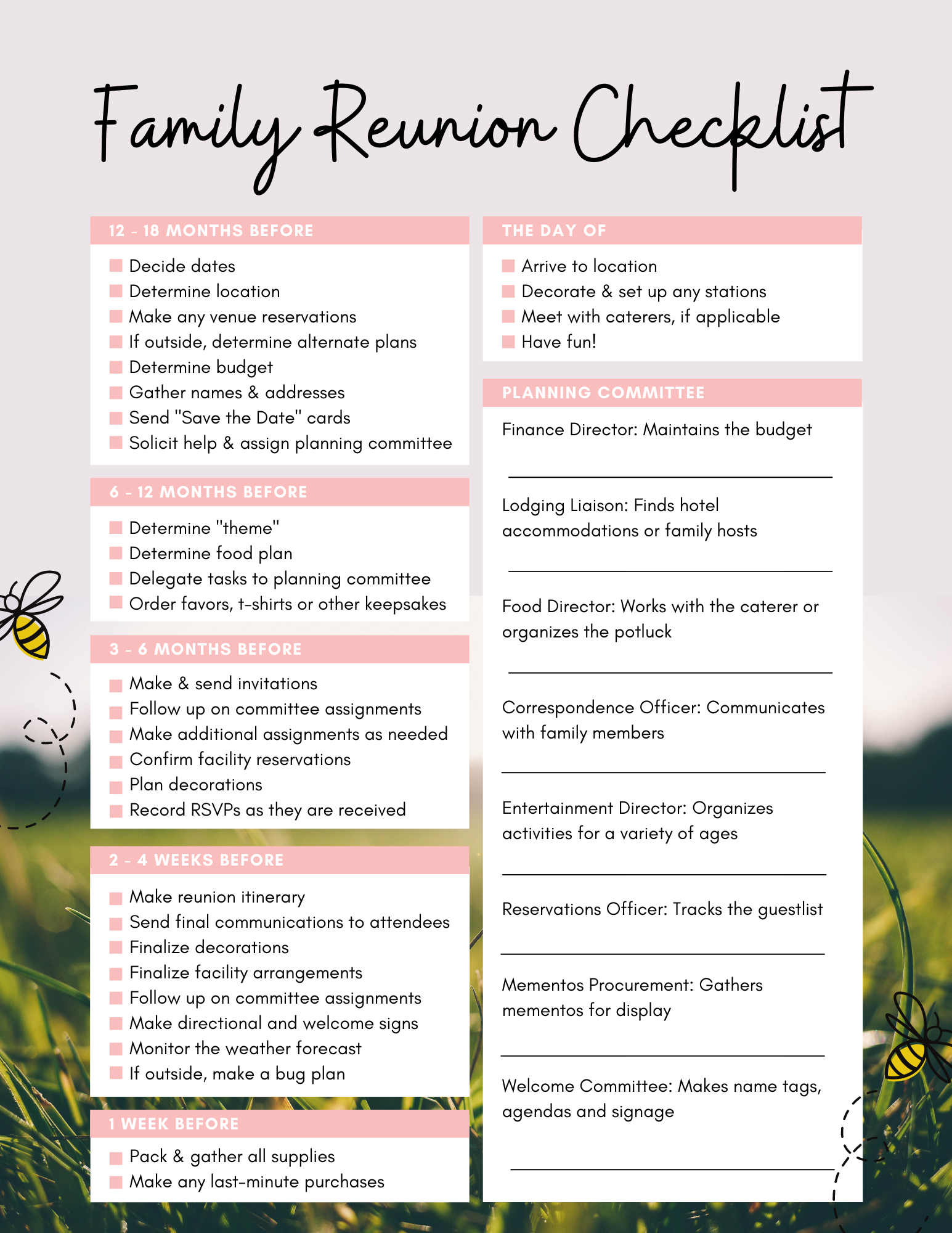
If you look further down on this webpage, I did post on Saturday, January 20, 2024, my first article is titled “Planning a Family Reunion in 2024”. This 2nd article is about completing a family reunion --- the lessons learned and tips.

I started over a year ago by googling for family reunion checklists, guides, and articles. I went under the Google search images page and typed in “family reunion checklist”. Here are a couple more resources.

Family Reunion Planning Checklist Free Download by Family Tree Editors
If you enter your email address, they will send you a free download of this checklist.
https://familytreemagazine.com/freebie/free-family-reunion-checklist/

Step-by-Step Family Reunion Planning Guide Free eBook by Family Tree Editors
If you enter your email address, you can get this planning guide for free.
https://familytreemagazine.com/freebie/step-step-family-reunion-planning-guide/

Family Reunion Checklist, Urban Indian Center of Salt Lake
https://uicsl.org/wp-content/uploads/2021/07/Family-Reunion-Planning-Cheat-Sheet.png https://uicsl.org/how-to-host-a-family-reunion-easily-and-effortlessly/

Start of my planning!
In the summer of 2023, one of my brother’s agreed to help me on this family reunion. We decided to hold it in the summer of 2024, and I contacted some of my cousins who are farmers to make sure it was held during a time when they could attend. I also asked around if anyone who would probably attend, if there were any wedding weekend dates booked.

I then started a table in Word on possible venue locations. I check online for their websites and phoned for some initial information. One mistake that I made was that my initial estimate of attendance was too high (300+ and in the end it was around 150). I was basing this number on the first family reunion and how many more cousins have come along, but times have changed. Back in 1993 many of the older aunts and uncles were alive and more involved in the reunion and book. These people were my Dad’s first cousins. Some also  knew their grandparents who came from Galicia.

In 2023 and 2024, we live in a different world. On the one hand it was easier to locate some cousins due to Facebook, Ancestry and search engines. On the other hand, people are more afraid of being contacted and especially sharing their personal information because of scams and fraud. Plus people are busier and visit less with cousins or are not interested in family history.

I set up a separate bank account and started to draft a budget. I started gathering relatives' contact information and created an Excel spreadsheet to record the info. In my email inbox, I created a new folder for this reunion and expanded it over time with subfolders.

My brother went with me to check out 3 venues. I initially had 10 venues on my list. We both also checked out a few places on our own. It is important to ask a lot of questions. There was one place that we really liked but the buffet quote was too high. Another beautiful venue in a neighboring town had columns in the main ballroom that blocked the view for some attendees. We were looking at the seating limits, deposit amount, buffet quote, extra costs, and what additional services were available. We settled on the Ukrainian Youth Unity Centre but only two weekends were still available for the next summer (2024). Depending on the location, you might have to book the venue 1.5 to 2 years ahead of time.

When we met with the UYUC manager, we were told lots verbally and I was busy taking notes. We picked the date on the June long weekend and made the deposit. When we contacted this venue months later to start on the details, there were some changes. A new manager, no longer an ice cream shop on the corner, and no longer picnic tables outside. We paid an additional $300 for a green lights garland hanging from the ceiling to the side walls. Little extras like this really added to the abundance. We used the in-house white table linens to save money. It was all about balance. On Google Maps you can see where this venue is located and what is around it.

Ukrainian Youth Unity Complex
https://www.uyuc.ca/


I decided on a theme and reunion colors. Green, gold, and white with sunflowers. I started by checking out Amazon.ca, Etsy, Michael’s, Party City, and Dollarama stores and borrowing from extended family members. I got some table decorations, also for the memorial table, front registration table, and photo booth props, etc. The Family Reunion banner was an excellent purchase and really stood out on the stage. The sunflower decorations were also purchased from Amazon.

MEHOFOND 10x7ft Family Reunion Backdrop Family Tree We are Family …
https://www.amazon.ca/dp/B0C7ZRFXTQ


We rented DJ equipment, and I learned at the reunion that this was a waste of money ($535.00). I should have asked more questions about the venue’s AV equipment. Actually, I needed to take one of my family members to check out their sound equipment at the venue. Today one only has to bring an iPad with a Spotify account and plug it into the venue’s sound equipment. We had a live singer so got a microphone from the DJ rental but no microphone stand. One of my cousins figured out that there was a steel pole from the centre ceiling on the stage that came down and he used some wiring to attach the microphone to the pole.


I asked my Ukrainian friends for a referral of a Ukrainian newcomer who creates live flower table centrepieces. Lesia was so reasonable. I picked up the centrepieces on Saturday morning, the day of the reunion so they were fresh and in good shape. They were such a hit at the reunion with cousins grabbing them at the end of the night when I announced that they could take them home. I had some wildflowers in the centrepieces to honor a cousin who had passed away from cancer. On the tables, there was green foil confetti to honor the farmers in our family and the small sunflower decorations to honor our Ukrainian ancestors. I can give serious inquiries Lesia’s contact info.

I had also picked up lots of children games and pinatas at Dollarama stores. I announced that the kids could take home all of the games. Just outside of the building was a large, landscaped area to set up the games for the kids. I did little personal things like getting clear labels at Staples then got an image online that I could add info to and put it on the jars that I got at Dollarama, for the table centerpieces. I tried to save money wherever possible.

Got a balloon air pump from Party City, liquor tickets from Dollarama, ordered USB sticks from Amazon, and other items from Walmart and Staples which saved time and money. It is worthwhile to shop around. Also being organized and having a good to-do list helped a lots. I took photos on my mobile phone. I got receipt books and made sure that I had checks and balances on recording the money that we were spending and especially the money coming in (who ordered what). I was collecting money for the reunion registrations, the 2024 family history book, or an USB stick with the first family reunion, PDF scan of the 1993 family history book and PDF of the 2024 family history book, etc.

I was left confused on what insurances I needed to get. The UYUC manager gave me a couple of names (PAL Insurance and Duuo) and two different types of insurance, event liability insurance and host liquor liability insurance (because we were providing the liquor and selling it). On the venue website, they list PAL Insurance (Canada) but I did not like all the questions that they were forcing me to answer on their website, e.g. marijuana coverage.

Duuo by Co-operators offers both insurances as a package and was so straightforward dealing with online and via email. Click on Insurance Get Quote button, then “I’m hosting an event”. It came to a little over $220.00 for 150 people, for one day.

Duuo by Co-operators
https://duuo.ca/

For the liquor license, you just go on the AGLC website, and it costs $25.00. We got a Special Events, private resale SEL license. https://aglc.ca/liquor/liquor-licences/apply-liquor-licence/liquor-licences-private-special-events

We went with Wine and Beyond Windermere to purchase the liquor. A staff person went over with us on the selections, keeping in mind items on sale and later sent me a quote via email including quantity, item number, description, unit price, taxable and sub total amount. We went with two kinds of beer, a couple different kinds of coolers, white and spiced rum, whisky, vodka and a case of each white and red wine. One thing to watch for is that you save on buying larger sizes but if it is open, then you can’t return it. The store gave me the number of servings for each, and I was able to figure out the cost per item. One mistake that I made was having different liquor tickets for the beer vs coolers, vs hard liquor vs wine. I should have just averaged all of this and only had one liquor ticket.

I sent email updates to my cousins, starting with a “Save the Date” newsletter. Included information on the different family branches, the venue details, some activities ideas, menu selection, family reunion website, and questions and input needed selection. This was sent out in early December, timed for family to talk about during the holiday season.

I found a good website to create a Kalynchuk Family Reunion page at MyEvents.com. They have lots of examples of other websites to assist you in getting started and good advice on putting on a reunion. I started with an outline in MS Word with a table of contents and started to fill in the information. I found this to be easier than working directly from the website design dashboard. I initially thought that more cousins would be involved on the website but instead the reunion website was used to register and check on the details. I got in touch with close to 300 cousins so was glad to have this set up. People could register on the website, but I took care of receiving the payments myself, directly. I found that the two fees and ticket surcharge plus they hold the money for at least 10 days was too much. Many cousins paid close to the reunion date and some even paid at the event or later on!

Family Reunion Planning Center, MyEvent.com
https://myevent.com/family-reunions/family-reunion-planning-center

Another mistake that I made was in purchasing name labels at Staples and late on the night before the reunion was trying to print off the names with details (which family branch). The label sheets got jammed in the printer and it was a disaster. I thought that this would be straightforward and easy to do. Instead, it needed to be done ahead of time, put on an USB stick and printed off at Staples.

Etsy.com/ca was a wonderful place to purchase images for the family history book including the cover page (Wheat Clipart). The Family Reunion Conversation Starters quotes were a big hit. We cut them individually and put them on the tables. I received a download in an email then put it on a USB stick and printed off in color at Staples.

https://www.etsy.com/ca/listing/1500670701/printable-family-reunion-conversation
https://www.etsy.com/ca/listing/1406776214/ukrainian-ethnic-embroidery-with-corners
https://www.etsy.com/ca/listing/1561954353/watercolor-ukraine-clipart-70-png-travel

We got large boxes of snacks (chips and snacks) at the Wholesale Club for the afternoon which was a good idea. The venue provided a coffee station with water and Tang drinks. I did not think about also having some food/snacks for later at night, near midnight. Some of my cousins ran out to Tim’s and got donuts!

I also canceled the Kalynchuk Family Cookbook project due to a lack of interest. I did up a display table on my family history and had friends there who had a table on Ukrainian culture and folklore.

I paid $100 for the large screen on the stage and brought my laptop with the 1993 family reunion video on it. A cousin was able to get it to play on a loop. This was a real highlight in the afternoon. Near the end of the event, I had two cousins approach me that they are willing to organize the next Kalynchuk Family Reunion (and it will not be 30 years from now). It feels so good to pass on the torch.

Cousins volunteered to cover the liquor ticket sales and registration tables, so I did not have to hire 2 staff. Also, the UYUC venue suggested at the beginning to hire 2-3 security guards, but we did not need to do this. There were no security problems at this reunion.

A good piece of advice I got for the next reunion is to have each of the tables have someone stand up and introduce everyone at the table and say how they are related to us. Cousins and siblings from the same family branch tended to sit at the same table.

Another piece of advice is to watch for cousins who are not acting in good faith. It is those naysayers and bullies that I am talking about. At this reunion, lots told me that they had a really good time and thanked me for organizing it. My focus was on the majority. I wanted them to have a wonderful experience, especially for the children and younger ones. They are our next generation.

How To Deal With Difficult Family Members at A Reunion
https://getting2theroots.com/difficult-family-members/

The results that I see from putting on this reunion is that more cousins have become friends on Facebook and more of them are attending family events, especially the younger ones. I am getting quite a few inquiries from cousins wanting the contact info to get back in touch with other cousins who they knew in their youth. There is also a huge interest in our great grandparents’ homestead which some of us visited on the Sunday right after the reunion.


Tuesday, May 7, 2024

Using Creative Non-Fiction Writing in a Family History Book

I am in the process of writing my second family history book. In 1993, I was lucky to have many relatives still alive, especially those who knew their parents and grandparents who came to Canada from the former Galicia under the Austria-Hungarian Empire in 1897.

Now 31 years later, I am finding it difficult to write stories about my great grandparents and their children. Whenever I hear that an elder relative is still alive, I rush out to visit them.

On April 23, 2024, I watched the Ukrainian Genealogy Group – NCR (Ottawa) webinar on “Ghosts in a Photograph" by Myrna Kostash. I was so impressed with Myrna that I went out and purchased her book, “Ghosts in a Photograph: A Chronicle” by NeWest Press, 2022.
http://ukrainiangenealogygroup-ncr.org/WebinarRecordings.html

Creative nonfiction is a genre of writing that uses elements of creative writing to present a factual, true story. Creative Nonfiction is focused on reality, as it relies on research to render events as accurately as possible. It must be scrupulous in one’s attention to detail like a journalist. Creative nonfiction seems to be a perfect match with family history writing especially with the earlier generations of one’s family and gaps in history.

There are numerous online courses and articles; to help understand this process of writing. There are also examples of short creative nonfiction writing online. I find it exciting to learn how to write true stories in a compelling way.

With the 2024 Kalynchuk Family History book, I am combining genealogy facts and stories from the 1993 family history book with the literature review of numerous Ukrainian Canadian, Ukraine and Galicia history books, articles, and online sources. We are lucky that the first wave of Ukrainian settlers to Western Canada has been well documented.

I am also using ChatGPT, EditGPT and Grammarly. However, I know to be cautious with ChatGPT as it does make up false things. This is called “hallucination" so this is why everything needs to be double-checked. Thank goodness for new technology and a new writing genre to assist me.

Photo by Aaron Burden on Unsplash


Being an introvert and enjoying getting into the “zone”, I look forward to taking on this challenge to create wonderful stories about my ancestors to include in the 2024 Kalynchuk Family History book.

Resources:

A Complete Guide to Writing Creative Nonfiction
https://www.masterclass.com/articles/a-complete-guide-to-writing-creative-nonfiction

Examples of Creative Nonfiction: What It Is & How to Write It
https://selfpublishing.com/examples-of-creative-nonfiction/

Creative nonfiction
https://en.wikipedia.org/wiki/Creative_nonfiction

How to Write Creative Non-Fiction
https://www.youtube.com/watch?v=q85nRfiHdV8

Ghosts in a Photograph: A Chronicle, Myrna Kostash
This book has won the 2024 Kobzar Book Award https://www.goodreads.com/book/show/61238396-ghosts-in-a-photograph

Monday, May 6, 2024

Using Genealogy Standards and Applying for a Certified Genealogist Credential

My goal is to receive my Certified Genealogist credentials and a specialization in Ukrainian Canadian or East European, one day. I have purchased a couple of books and have started to check out the following organizations and resources. If you do not want to purchase books and materials, then consider looking for this information online or at your local library or through your local genealogy society.

Suggestions are to attend genealogy conferences, e.g., Roots Tech, webinars and courses, educational seminars and workshops, join genealogy organizations, subscribe to genealogy journals and magazines, check out your local archives, libraries, research centers, etc., network with fellow family historians, genealogists, librarians and archivists, volunteer, work on your own family research and genealogy, write a family history research article (case study) and submit it to a journal for peer review, join a study group, do pro-bono work to gain experience, interact on genealogy Facebook pages and discussion forums, join an association of professional genealogists then prepare and apply for Certification and/or Accreditation.

Unknown source
Five essential steps for accurate research:

1. Reasonably exhaustive research has been completed.

2. Each statement of fact has a complete and accurate source citation.

3. The evidence is reliable and has been skillfully correlated and interpreted.

4. Any contradictory evidence has been resolved.

5. The conclusion has been soundly reasoned and coherently written.

6. “The Genealogical Proof Standard isn’t a device per se,” says Ison, “but it’s a process that will help us to determine what we know, helps us decide what we want to learn, helps us explain our work to others, gives us confidence about the direction we’re going, is the basis for approaching difficult research problems using indirect evidence, and lastly, it helps us to feel secure and safe in our conclusions.”

The above is based off a book written by Christine Rose, entitled Genealogical Proof Standard: Building a Solid Case. https://www.familysearch.org/en/blog/understanding-the-genealogical-proof-standard

The following organizations promote professional standards in genealogical research. They provide information about becoming a professional genealogist.

Board for Certification of Genealogists
https://www.bcgcertification.org/

International Commission for the Accreditation of Professional Genealogists (ICAPGen)
https://www.icapgen.org/

Association of Professional Genealogists (APG)
https://www.apgen.org/cpages/home

National Genealogical Society (NGS)
https://www.ngsgenealogy.org/

The following website has an excellent summary of the standards and guidelines from the National Genealogical Society and the International Institute of Genealogical Studies.

Genealogical Standards and Guidelines - International Institute
https://www.familysearch.org/en/wiki/Genealogical_Standards_and_Guidelines_-_International_Institute

Photo by Aaron Burden on Unsplash

Genealogy Standards Books:

Genealogy Standards, second edition revised, 2021
Board for Certification of Genealogists (BCG)
https://bcgcertification.org/product/genealogy-standards-2d-edition/

Mastering Genealogical Proof by Thomas W. Jones
https://www.ngsgenealogy.org/mastering-genealogical-proof/

Genealogical Standards of Evidence: A Guide for Family Historians by Brenda Dougall Merriman
https://archive.org/details/genealogicalstan0000merr

Evidence Explained: Citing History Sources from Artifacts to Cyberspace by Elizabeth Shown Mills, Second Edition 2009, and Third Edition 2015, https://www.evidenceexplained.com/

Evidence! Citation & Analysis for the Family Historian by Elizabeth Shown Mills, 1997
https://www.amazon.ca/Evidence-Citation-Analysis-Family-Historian/dp/0806315431/ref=sr_1_1


Articles and Videos:

Are You Ready to Become a Professional Genealogist?
Association of Professional Genealogists (APG)
https://www.apgen.org/cpages/are-you-ready

Becoming a Professional Genealogist
National Genealogical Society (NGS)
https://www.ngsgenealogy.org/free-resources/becoming-a-professional-genealogist/

Thinking About Becoming a Professional Genealogist? by Crista Cowan, Ancestry – YouTube
https://www.youtube.com/watch?v=FwMIVt4e1qQ

Becoming a Professional Playlist – Just Genealogy by Craig R. Scott, CG, FUGA
https://www.youtube.com/playlist?list=PLlUfNNfhGu_Yc5autzobj8xu9eTafo96f

Code of Ethics and Professional Practices - Association of Professional Genealogists (APG)
https://www.apgen.org/cpages/code-of-ethics


Peer-Guided Study Groups:

ProGen Study Groups, Inc., Virtual course
https://progenstudygroups.com/

GenProof Study Groups, Inc., Virtual course
https://genproofstudygroups.com/

Photo by Debby Hudson on Unsplash

Genealogical Studies Courses:

Boston University Certificate in Genealogical Research
15-week online, non-credit course
https://genealogyonline.bu.edu/certificate

Review of the above BU course:
https://genesandroots.com/2019/01/04/my-review-of-the-b-u-certificate-in-genealogical-education-course/

NGS American Genealogical Studies Course
https://www.ngsgenealogy.org/genealogy-courses/
https://www.ngsgenealogy.org/advskills/

International Institute of Genealogical Studies
https://genealogicalstudies.com/

You can also take some intermediate-level courses at the following institutes.

Genealogical Research Institute of Pittsburgh (GRIP)
https://grip.ngsgenealogy.org/

Institute on Genealogical and Historical Research (IGHR)
https://ighr.gagensociety.org/

Salt Lake Institute of Genealogy (SLIG)
https://slig.ugagenealogy.org/index.php


Genealogy Beginner Courses:

Introduction to Family History Research by Udemy
https://www.udemy.com/course/introduction-to-family-history-research/

Tracing Your Family Tree courses
Alberta Genealogical Society (AGS) and Edmonton Branch
Saturday, May 11, In the Beginning, Organizing Your Family History
Saturday, June 8, Finding Metis and Indian Ancestors, French Ancestors in Canada and Beyond
Saturday, June 22, DNA Detective - DNA
https://www.edmontongenealogy.ca/events

Wednesday, February 7, 2024

Obstacles in Genealogy Research

On February 6, 2024, I took in a “Make Your Story Matter” free, live, online class with Leslie Leyland Fields who is from Kodiak Island, Alaska. Leslie shared with us the writing process which she has developed and perfected over 30 years. The focus of this zoom session was to encourage the participants to start writing their own stories. In the agenda, she told us that “we’ll discover how to free our memories, our creativity and our wisdom.”

Leslie is an international speaker, teacher, and award-winning author of 14 books. Her books have been translated into at least ten languages including Ukrainian, Polish, Slovak, German, French, Chinese, and Korean.

Leslie Leyland Fields
https://www.leslieleylandfields.com/

During her session I realized that a lot of what was being covered including the reasons listed in the zoom chat by participants, are obstacles which relate to genealogy research too. Obstacles listed in the chat include fear, lack of time, how to begin, perfection, lack of discipline, so much material, pressuring myself, interruptions, etc.

I have met many people interested in Ukrainian Canadian genealogy through the Ukraine SIG at the Alberta Genealogical Society and at the display tables which I had at 3 events this last summer. From my own obstacles and what I have heard from others on theirs, I find common themes.

https://storables.com, Computer Data Storage

 After this session I did a google search and found 3 excellent articles on obstacles in writing and reviewed them for cross overs to genealogy research and especially how they relate to my own life. I found some good tips and leads to some new apps.

Leslie mentioned the question, “who will care? and told us that “we store in our minds the stories that matter to us.” What are the stories that you remember of your own lives and what are the stories that you remember of your ancestors, cousins, neighbours etc.?

I realize that writing is a different skill set than researching but there are overlaps with the obstacles. Let’s start first with a couple of real good articles on obstacles involving writing.

Top 11 Toughest Writing Challenges and How To Overcome Them
https://becomeawritertoday.com/writing-challenges/

10 Obstacles to Writing a Book and How to Conquer Them
https://thewritepractice.com/writing-a-book-obstacles/

21 of the Biggest Challenges Writers Face and Their Solutions
https://writingtipsoasis.com/biggest-challenges-writers-face/

I printed off these articles and circled, underlined, and highlighted some of the material. Some of the articles don’t print off nicely so I had to copy and paste the information into Word in order to print it off in an easy format to read. I am old school on this!

I find that it is a good idea to reflect on what is holding me back, what is interfering and how I can do things better, to be more effective, and efficient. This is called, “reframing” which can be a powerful tool when we feel stuck or held back.

1. Identify the obstacles.
2. Question your assumptions.
3. Shift perspective.
4. Set clear goals.
5. Break it down.
6. Seek support.
7. Celebrate progress.

When I did the 1993 Kalynchuk Family History book, I initially reviewed family history books done by others. I created a table of contents (an outline) from this exercise and also photocopied some examples to refer to. This is what got me started.

There are numerous resources available to assist one with writing your family history.

9 Tips for Getting Started on Writing Your Family History
Editors of Family Tree Magazine
https://familytreemagazine.com/storytelling/tips-getting-started-writing-family-history/

The Non-Writers Writing Guide to Write Your Family History
https://www.creativefamilyhistorian.com/writing/family-history-non-writers-writing-guide/

How to Write Your Family History
https://www.thoughtco.com/steps-to-writing-your-family-history-1422877

Write Your Family History with Devon Noel Lee
https://www.youtube.com/@WriteYourFamilyHistory


Photo by Yura Fresh on Unsplash


One tip that I got from one of the above articles (Top 11...) is if I write in Calibri and edit in a different font, the change tricks my brain into thinking that I am reading a different piece of writing. I also know that I have trouble with grammar and am always writing on sticky notes and small pieces of paper. One thing that excites me is to discover new apps that can make my life easier.

18 Best Grammar Checker Tools: Ranked and Rated
https://becomeawritertoday.com/best-grammar-checker/

Scrivener – a book writing software
Scrivener is a word-processing program and outliner designed for writers. The free trial runs for 30 days of use.
https://www.literatureandlatte.com/scrivener/overview

ColorNote – a notepad app.
This is available on the Google Play for my android mobile device.
https://www.colornote.com/

And to finish this article, I google searched on “obstacles in genealogy” and found the following. Lately it is the indirect evidence which is giving me some new leads on my family research. And I find that using timelines, really helps when I am checking out dates. I am also expanding which relatives I am researching on as I find that siblings, cousins, and extended family members have treasures of information and pictures!

Common Obstacles Found in Genealogy Records and How to Overcome Them
Legacy Tree Genealogists
https://www.legacytree.com/blog/overcoming-obstacles-genealogy-records

4 Ways to Solve Genealogy Problems
By the Family Tree Editors
https://familytreemagazine.com/research/4-tips-for-solving-genealogy-problems/

5 Common Genealogy Errors (and How to Avoid Them)
By Andrew Koch, at the Family Tree Magazine
https://familytreemagazine.com/research/5-common-genealogy-errors/

13 tips to try when your family tree leaves you stumped
Find My Past UK Blog
https://www.findmypast.co.uk/blog/help/family-history-brick-walls

Ten Common Genealogical Problems – and How to Solve Them

Saturday, January 20, 2024

Planning a Family Reunion in 2024

A family reunion is an occasion when many members of an extended family congregate. I am in the process of planning a family reunion in June of 2024. I have found some family reunion articles which I am listing below. I also google searched for family reunion checklists and worksheets in PDF and as images then saved them on my computer. I then compared them for the best ones. This gave me lots of ideas to work with.

I have created a family reunion website at the MyEvent.com for my family members. This website was fairly easy to set up and the monthly fee is reasonable. With this website, the cousins who can’t make it to the reunion can still interact with each other as it has pages like family profiles, photos, memorials, family memories, family recipes and guest book besides the reunion schedule, registration, travellers’ information etc. They have lots of good information on their website and also send you weekly email newsletters.

https://myevent.com/family-reunions

I coordinated the first family reunion in 1993 and learned a lot from this experience. This time I am making sure that I recruit more volunteers in advance and have set up a reunion planning committee. With the first family reunion, I was working a full-time job and this time I am retired. I also have one brother living in the same city as me who is very interested in this and is helping. In the beginning I listed out some potential locations and he went with me to see them. It is very important to bounce off ideas with family members and friends.

To cut down on expenses, we are looking at borrow items like the photo booth and props, outdoor games, decorations, etc. And I am looking at Etsy for some purchases and doing some DIY projects. One can even rent the DJ equipment with an iPad and pay a third of the price compared to hiring a DJ with equipment.

I am also approaching people who I know in the local Ukrainian volunteer community to assist with the Ukrainian entertainment, staffing and table displays etc. For example, I might have a lead on a Ukrainian newcomer who can edit the 1993 video of our last family reunion. The staff who we have to hire at the event (liquor ticket sellers, security), I am hoping to get Ukrainian newcomers. I am lucky that some of my cousins still speak Ukrainian as this will add to our heritage theme.

We are also holding this reunion at the Ukrainian Youth Unity Complex in Edmonton, AB so of course we will be served Ukrainian food at the banquet buffet!  

Social media has made it a lot easier to locate cousins especially with Facebook. And obituaries have helped to fill in the information on marriages, children and grandchildren.

As mentioned in my previous article, I am using Evernote and Trello to keep organized and on track.

One of the exciting new projects is a family heritage cookbook and there are lots of ideas online and even some templates. However, note that the printer told me to be careful on which fonts I use as they can get messed up with the printing equipment. One can print the cookbooks locally at a reasonable price and with a short timeline. I checked out a few different printers’ websites first. I am using College Copy Shop in downtown Edmonton at https://collegecopyshop.com/

One of the hardest tasks is locating all of the cousins as my ancestors came to Canada in 1897 and I am inviting all of the descendants of the first couple who stepping on Canadian soil, Elko and Anastasia Kalynchuk. Quite a few of their children, had many of their own and it continued! My estimate is that I have at least 300 cousins! Thirty years ago in 1993, I was in contact with more of my elder Aunts and Uncles. Now I am mainly working with a new generation, who are spread around the world. And now I am the Auntie. I am also doing a second family history book, this time for the period of 1994 - 2024.


Courtesy of cottonbro studio at Pexels.com


Family Reunions: 10 Steps to Plan (and Save Your Sanity)
Family Tree Magazine.com, by Mary Snyder
https://familytreemagazine.com/reunions/10-steps-to-family-reunion-success/

Family Reunion Planning Checklist Free Download
By Family Tree Editors (excellent checklist)
https://familytreemagazine.com/freebie/free-family-reunion-checklist/

The Complete Guide to Planning a Memorable Family Reunion
KOA.com, August 29, 2023
https://koa.com/blog/family-reunion-planning-guide/

Checklist: How to Plan a Family Reunion
Join Cake.com, by Sarah Kessler
https://www.joincake.com/blog/family-reunion/

Family Reunion Checklist
https://www.familyreunionhelper.com/media/docs/family_reunion_checklist.pdf

2024 Genealogy Goals and a Roadmap

Goals are a crucial part of achieving success with genealogy. Goals assist you in developing a roadmap to get from where you are, to where you want to be. The clearer and more defined that your roadmap is, then the easier it will be to follow it. The beginning of a new year gives us a reason for a new start or a restart then to evaluate our previous genealogy activities. And to set new goals and a new roadmap for 2024.

It is time to get organized, or at least more organized! We all have limited resources and time.

Your 2024 Genealogy Research Plan (Organized by Month) by Sunny Jane Morton
Family Tree Magazine https://familytreemagazine.com/research/genealogy-research-plan/

Setting Genealogy Goals:

The best way to start listing out your goals, is to use the SMART method.

“S” = a specific outcome

“M” = measurable

“A” = achievable/attainable

“R” = relevant/realistic

“T” = time-based/time-bound

The 15 Minute Plan For Achieving Your Genealogy Goals by Patricia Hartley
Family History Daily, originally published in Jan. 2019, updated Dec. 2020
https://familyhistorydaily.com/genealogy-help-and-how-to/achieving-genealogy-goals/

How to Set Genealogy Goals
Heritage Consulting
https://www.heritageconsulting.com/how-to-set-genealogy-goals/

Image by kalhh from Pixabay


Having a Genealogy Toolkit (or dashboard or hub):

A genealogy toolkit is a collection of frequently used family history tools, resources, and processes kept together for easy access. This includes all of our paper and computer files and folders, software programs, books, databases, and hardware etc. Tools include such as worksheets, checklists, planners, charts, and templates. Resources include books, genealogy databases, newspapers, websites, and registers etc. And processes include guides, instructions, location specific lists etc.

  • Look at how you structure the folders on your hard drive or cloud storage and also with your paper folders, you should use the same labeling system.
  • Create a dashboard in a project management software (e.g. Evernote, Trello)
  • Create a list of the web links you use in a Microsoft Word or Google Docs file. I have also seen some people using an Excel spreadsheet instead. This is more organized than relying on bookmarks. Many years ago, when I worked on environmental scanning and foresight, I had a Word document with the various categories and web links I was researching daily on. It was very easy to update in this format.

Regarding the creating of a toolkit, first you create a framework by deciding the broad categories of what you’ll include. Then look at the contents and split them out into the relevant categories. Finally choose where your toolkit will live and what your toolkit structure will be. This must be easily accessible so you can use it in every research session.

My first career was as a chef and my kitchen needed the equipment to be set up properly and the food prep done and easily accessible for the lunch hour rush. This is how I am looking at setting up my genealogy toolkit now. I want it to be as smooth as the kitchen line was. Your genealogy toolkit is a hub of information that makes your life easier. Once it’s set up, it should save you time because everything you typically need for each research session is at your fingertips.

I have been also looking at various office layouts and what containers and furniture etc. will work best for me. For example, I have books in two different rooms which need to be sorted. It has also been my goal to go more digital instead of so much paper files. I do have a scanner in my home office.

I have been using Evernote for quite some time but have lately been hearing about Trello. I am currently setting up on Trello to manage all of my genealogy goals, research plans and the various projects and activities which I am responsible for.

With Evernote, I use it for various notes, to-do-lists, and resources etc. and have them organized by topic (called Notebooks) and articles (called Notes). It lists the date and time created and last updated, title, Notebook, tags, and size. You are able to use various text and drop in images etc. I am happy with the free version as I don’t need all the bells and whistles.

Trello is a project management app that uses boards and cards. It is better for visual organization and team collaboration. Evernote is a note-taking program that focuses on organization and productivity. It is better for personal organization and cross-device syncing. If you want a solid management program to create, assign, follow, and complete tasks, go with Trello. If you want a note-keeping and documentation app with a project management touch, go with Evernote.

Trello 
https://evernote.com/

Image by Pexels from Pixabay


Creating a Research Log:

A research log can help you not only organize your research finds, but also identify areas where you need to do more research. It also helps with instant recall and the reducing of do-overs. And finally, it helps you to analyze the data collected. A good habit to get into doing is creating research logs.

To create a research log for genealogy research, you should:

  • Choose your preferred tool and template.
  • Establish a workflow that incorporates your log.
  • Create a separate research log for each objective.
  • Follow your research plan and add entries to your log for each result from genealogy sources you search.
  • Create source citations for each entry.

Research Logs, FamilySearch
https://www.familysearch.org/en/wiki/Research_Logs

Why You Need a Genealogy Research Log (and How to Create One)
Family Tree Magazine, by Vanessa Wieland
https://familytreemagazine.com/research/tips-conquer-genealogy-research-log/

Research Log Spreadsheet (for free)
Thomas MacEntee at Genealogy Bargains
https://geneabloggers.us5.list-manage.com/subscribe?u=e6b48e8de3ee2e5430b75a4d5&id=98e427340